
For mid-sized suppliers, sustainability pressure often arrives through customer requirements: a tender question, an emissions data request or a supplier assessment. Responding confidently depends on clear ownership, reliable evidence and a process the business can repeat.
The GlobeScan–BSR State of Sustainable Business 2026 research helps explain the pressure upstream. Its April–May 2026 survey covered 124 sustainability professionals at companies with revenues above US$1 billion. Regulatory requirements were identified by 76% of respondents, compared with 31% in 2016. Consumer or customer demand rose from 21% to 44%, although the category was described as consumer demand in 2016.
These are findings about large companies, rather than a survey of Australian mid-sized suppliers. The implication for suppliers is commercial: the expectations placed on major customers can flow through procurement and contract requirements.
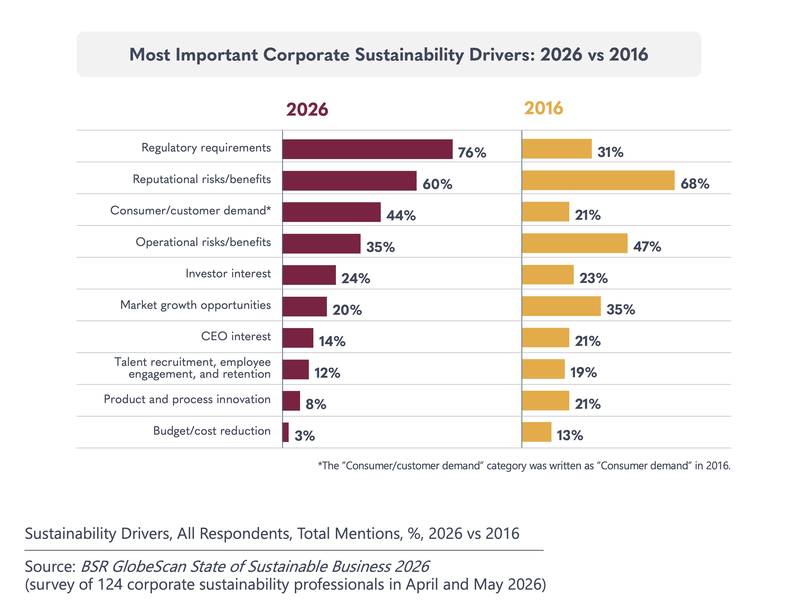
Source: GlobeScan–BSR State of Sustainable Business 2026. The 2026 survey covered 124 corporate sustainability professionals. The consumer/customer demand category was labelled consumer demand in 2016.
That is an important finding for large corporates. It is also an important signal for the mid-sized businesses that supply them.
For many mid-tier organisations in construction, resources and manufacturing, the driver may not feel like regulation at first. It often arrives as a tender question, a supplier code of conduct, a prequalification requirement, an emissions data request, a modern slavery questionnaire, a safety and environmental performance schedule, or a procurement conversation with a major client.
In other words, the regulation may sit upstream, but the pressure lands commercially downstream.
The pressure does not arrive neatly
For a large listed company, sustainability expectations are increasingly tied to formal disclosure, regulatory reporting, investor scrutiny and reputational accountability. These pressures are substantial, but they usually sit inside a larger governance, legal, risk and reporting structure.
For a mid-sized supplier, the experience is different. The same external expectations are often translated into multiple client requests, each with different wording, timeframes, evidence requirements and levels of maturity.
A manufacturing business supplying several national customers may be asked for site-level energy data by one client, Scope 3 emissions information by another, supplier diversity information by a third, and evidence of environmental management controls by another. A civil contractor may face different sustainability schedules across tenders, even when the work being delivered is operationally similar. A resources services provider may be expected to demonstrate governance, safety, workforce, environmental and community controls long before it has a dedicated sustainability function.
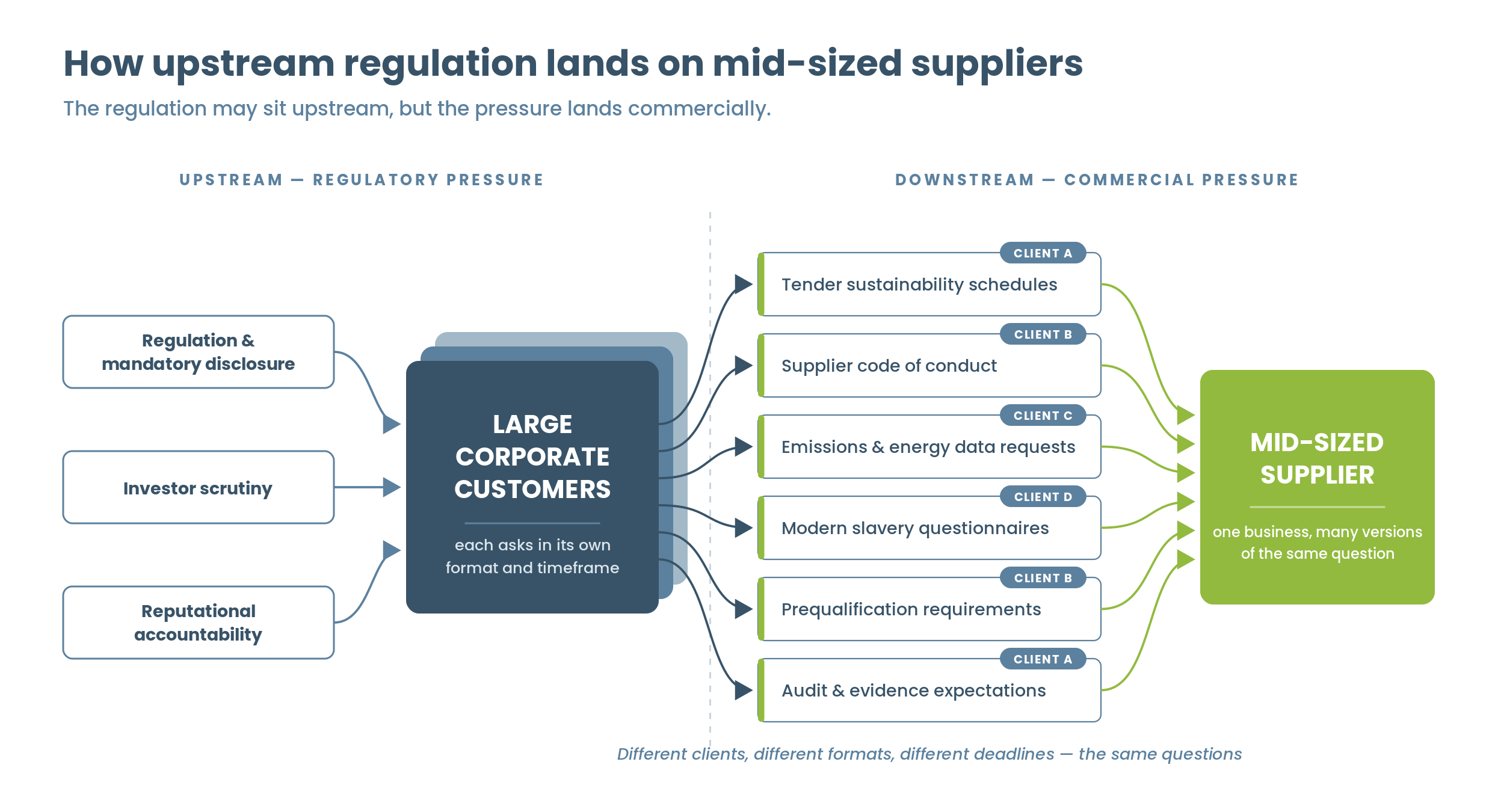
Source: Everfocus (2026). Diagram developed by Everfocus.
This is where the pressure builds. Not because the business lacks intent, but because the operating system has not caught up with the expectations being placed on it.
Customer demand becomes a systems problem
The common misread is to treat each sustainability request as a separate administrative task.
That may work once or twice. It does not work when requirements become recurring, when different clients ask similar questions in different formats, or when tender deadlines compress the response window.
At that point, sustainability becomes a workflow problem. Who owns the response? Where is the data stored? Which figures have been checked? Which policies are current? Which commitments have already been made to clients? What can the business evidence today, and what is still aspirational?
Without clear ownership, the work is pushed across HSEQ, finance, HR, procurement, operations and senior leadership. The organisation responds under pressure, often with reasonable answers, but with no repeatable system. The next request starts the process again.
That is the hidden cost of customer demand. It consumes management time, increases the risk of inconsistent claims, weakens tender confidence and makes sustainability feel like a burden rather than a business capability.
Mid-sized businesses have a different set of drivers
The GlobeScan and BSR research points to a weakening of several traditional business-case drivers in large corporations, including growth opportunities, innovation, operational benefits and cost reduction.
For mid-sized suppliers, the picture may be more mixed.
Regulation matters, but often indirectly. Investor interest may be less relevant unless the business is seeking capital, preparing for sale, or operating in a highly scrutinised market. Reputation matters, but usually through relationships, tenders, licence to operate and client confidence rather than public brand visibility.
The more immediate drivers are often:
- Customer access. Sustainability capability is increasingly part of staying eligible for preferred supplier panels, major tenders and long-term contracts.
- Tender competitiveness. Buyers are not only asking whether a supplier has a policy. They are asking whether the business can provide credible data, demonstrate controls and show improvement over time.
- Risk transfer. Large organisations are under pressure to understand and manage impacts across their value chains. Some of that burden is passed to suppliers through contracts, reporting requests and audit expectations.
- Operational resilience. Energy, waste, workforce, safety, supply chain and governance issues are not abstract ESG topics. They affect cost, continuity, productivity and delivery confidence.
- Executive confidence. Boards and leadership teams need to know what the business has committed to, what it can evidence and where the gaps sit.
So for many mid-sized businesses, sustainability is not being driven by one force. It is being driven by the convergence of customer expectations, tender requirements, risk management and operational credibility.
Relieving the pressure starts with standardisation
The practical response is not to build a corporate sustainability department before the business needs one. It is to create a fit-for-purpose operating system that makes customer requests easier to answer, easier to evidence and easier to improve over time.
That usually starts with mapping the recurring requirements across major clients and tenders. Most organisations discover that the questions are not as random as they appear. They tend to cluster around emissions, energy, waste, workforce, safety, procurement, governance, ethics, modern slavery, diversity, community impact and management systems.
Once those clusters are visible, the business can build a common evidence base. This should include approved policies, current metrics, reporting boundaries, responsible owners, source documents, improvement actions and agreed language for tender responses. The aim is not to create a glossy sustainability report. The aim is to stop rebuilding the same answer from scratch every time a client asks.
The next step is ownership. Sustainability data rarely sits in one place. Finance may hold spend and utility data. HSEQ may hold environmental incidents, audits and site controls. HR may hold workforce metrics. Procurement may hold supplier information. Operations may understand what is actually happening on site.
A practical system makes those handoffs clear. It defines who provides the information, who checks it, who approves it, and where it is stored for reuse. Everfocus’s ESG and Sustainability Deep Dive helps leadership teams assess their current capability and define a practical improvement roadmap.
The goal is credible confidence, not perfect maturity
Mid-sized businesses do not need to pretend they have the same sustainability architecture as a multinational. In fact, overclaiming can create more risk than underdevelopment.
What large corporate customers usually need is confidence that the supplier understands the requirement, has control over its material issues, can provide reliable information, and has a practical improvement pathway.
That means being clear about three things:
- What the business can evidence now.
- What it is actively improving.
- What it is not yet ready to claim.
This is where sustainability becomes commercially useful. A supplier with clear data, consistent governance and a realistic roadmap is easier for a major customer to trust. It reduces friction in tenders, improves the quality of client conversations and gives internal teams a stronger basis for decision-making.
The practical test for leaders
A mid-sized supplier feeling pressure from customer sustainability demands should test its current state against five questions.
- Can we identify the sustainability requirements that appear most often across our major clients and tenders?
- Do we have one reliable place for approved data, policies, evidence and commitments?
- Is ownership clear across finance, HSEQ, HR, procurement, operations and leadership?
- Can we distinguish between what we can evidence today and what is part of our improvement roadmap?
- Are we using customer demand to build a repeatable capability, or are we still responding one request at a time?
The shift identified in large corporations matters because it will continue to move through supply chains. For mid-sized B2B suppliers, the task is not simply to absorb more pressure from their large corporate customers. It is to convert that pressure into a practical system.
The businesses that do this well will not only respond faster. They will tender with more confidence, reduce the risk of inconsistent claims and give their major customers a clearer reason to keep working with them.
Questions executive teams often ask
Why can sustainability requirements affect suppliers without a direct reporting obligation?
A major customer may need supplier information to meet its own reporting, procurement or risk-management requirements. The supplier needs to understand the specific request, its contractual context and the evidence required to respond.
Where should a mid-sized supplier start?
Review recurring requirements across major customers and tenders. Identify the information already available, assign owners and create an approved evidence base that can be maintained and reused.
Who should own the response?
An executive should be accountable for the outcome, with a defined person coordinating the response and the relevant functions owning their data. Finance, HSEQ, HR, procurement and operations need clear responsibilities for preparing and checking information.
For more on accountability and delivery, read Do I need a governance framework for my business?


