
By Ryan Hollis, everfocus
For many businesses in construction, resources and manufacturing, sustainability now comes with a growing list of requests. Clients want emissions data, tenders ask for evidence of responsible sourcing, and boards need to understand changing reporting requirements. It's easy for these newer demands to take up much of the conversation. Yet protecting the people doing the work is still likely to be the most important sustainability priority in day-to-day operations.
Safety has a clear place in Environmental, Social, and Governance (ESG). It affects the health and wellbeing of employees and contractors, and relies on good decisions, clear responsibilities and the resources to do the work safely. The challenge is making sure that commitment carries through to what happens on site, in the factory or during a shutdown.
Safety is already part of the sustainability picture
This connection is clear in the way major Australian industrial businesses describe their priorities. BHP puts the safety of its operations and health of its people first. BlueScope places safety and wellbeing first within its sustainability approach to people and communities, while CIMIC includes safety leadership alongside its environmental and business results. Each business has its own priorities, but safety is clearly part of the wider sustainability agenda.
The Australian data also shows why it needs continued attention. Safe Work Australia's 2026 statistics record 41 construction, 15 manufacturing and seven mining worker fatalities from traumatic injuries in 2025. Those figures don't include deaths from occupational disease, so they tell only part of the story. Even where safety systems are well established, there's good reason to keep checking how they work in practice.
Clear responsibilities make a difference
Many businesses already have safety policies, procedures and training in place. As the business grows, keeping everyone working to the same expectations can become more difficult. New projects, additional sites and different contractors bring more people into the process, often with different ways of working. This is where gaps can develop, despite everyone's good intentions.
Take a construction project where hired plant needs maintenance. The principal contractor, plant provider and maintenance contractor all have a part to play. If the work programme changes, the people available to plan and authorise the job may change too. Someone needs to check that the revised arrangements are understood and that everyone knows what they're responsible for.
Sorting this out before the job begins helps protect workers and makes planning more dependable. Leaving it until the maintenance team arrives can mean delays, repeated discussions and pressure to recover lost time. Clear responsibilities give the team a better starting point and help leaders understand whether the business can deliver on its safety commitments.
A procedure needs support to work well
Hazardous-energy isolation, also known as lockout tagout (LOTO), is a useful example. It's part of the system used to control energy that could harm people during work on plant. WorkSafe Queensland's guidance places isolation within the wider safety management system, including risk controls, worker consultation and competent people. The procedure needs all of these elements working together.
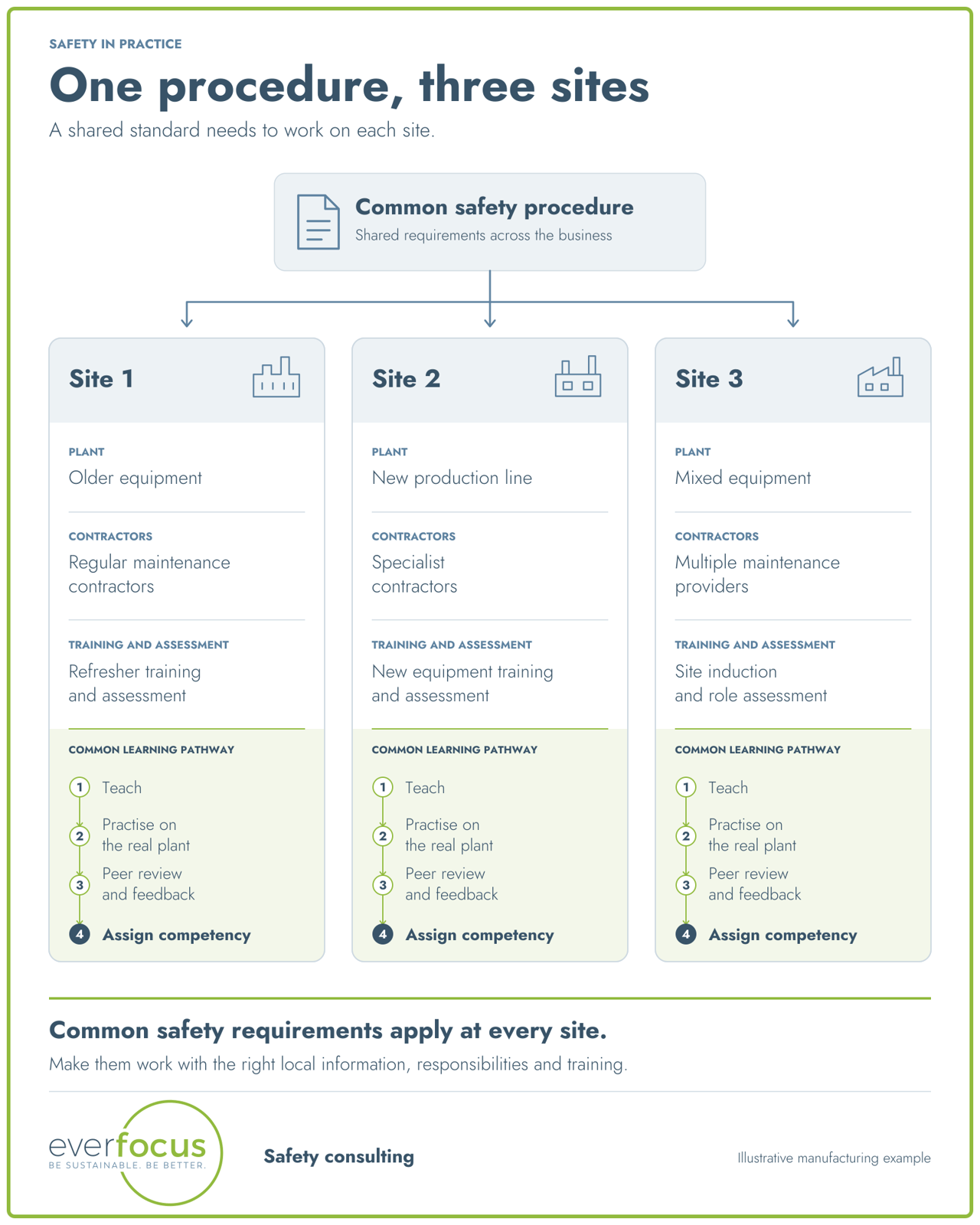
Consider a manufacturer with three sites using the same corporate isolation procedure. Over time, each site has developed different contractor arrangements, training records and ways of planning maintenance. The plant information available to workers may also vary. Updating the procedure is useful, but the rollout needs to deal with these local differences as well.
A good starting point is to involve the people who plan, operate and maintain the equipment. They can explain where instructions are difficult to use, where information is missing and where responsibilities are unclear. Operations, maintenance, engineering and the safety team can then work through those issues together, with the relevant technical input. Contractors also need to understand how they fit into the site's arrangements.
Training needs to connect to the work people are expected to do. Completing a course is one part of that process; practical assessment helps establish whether someone can apply what they've learned in their role. Records should make it clear what each person has been assessed and authorised to do. This becomes particularly important when people move between sites or take on different responsibilities. The model of teach, practice then peer review is a powerful tool to use in embedding safety training like this.
Once the changes are in place, the business needs to check whether they're working. Field verification means checking how the process and its safety controls are being applied where the work happens. If the same problem keeps appearing, it may be time to improve the instructions, information, training or resources available. Recording the issue is the start; someone needs to follow it through and check that the change has helped.
Give leaders a clear view of what's working
Boards and executives need information that helps them understand the work behind the safety report. Training numbers and injury figures are useful, but they don't show everything. Leaders also need to know whether the controls that prevent serious harm are designed effectively, physically in place and working as expected. A recent maintenance job or shutdown provides a practical example to work through with the team.
You could start with who was responsible for the key decisions and whether that stayed clear through any changes or handovers. Then look at how the business checked that people could carry out their roles and that the required controls were effective. Finally, follow any problems raised during the work: who dealt with them, what changed, and whether the response fixed the issue. This gives leaders a much clearer picture of where attention is needed.
Practical support for safety improvement
At everfocus, safety consulting is part of our broader sustainability and governance offering for Australian construction, resources and manufacturing businesses. We help organisations review safety management systems, develop practical improvement roadmaps and implement changes, including hazardous-energy isolation and LOTO programmes. That means working through responsibilities, processes, training and checks so the improvements become part of everyday operations.
If a safety process involves several sites, teams or contractors, a focused review can help clarify where to start. Speak with Ryan about your organisation's safety improvement priorities. The aim is to give your people a process they can use and your leadership team confidence that it's working.


